Kilmainham Gaol

the Kilmainham Gaol was the one thing, above all others, that I wanted to see while in Dublin. it was used for the Daniel Day-Lewis film “In the Name of the Father,” though the prison ceased to function as such in 1924, and a trip here seemed to cap my interest in the legacy of conflict in Ireland.

construction on the prison began in 1796 and construction of both wings reflects the prevailing beliefs in penal reform at the time. the west wing is dark and initially the hallways had no natural light. the cells were packed beyond capacity almost as soon as the prison opened, dozens of people sharing a single cell. unlike now, prisoners were neither segregated by age nor gender, and oftentimes entire families would be shut up together. despite the cramped quarters and general squalor of the prison, during the famine, Kilmainham and other jails provided an acceptable alternative to starving on the street. you could commit a petty crime and get locked up for a day or two, where you were guaranteed three square meals and shelter, more than you could say for living on and begging in the streets.

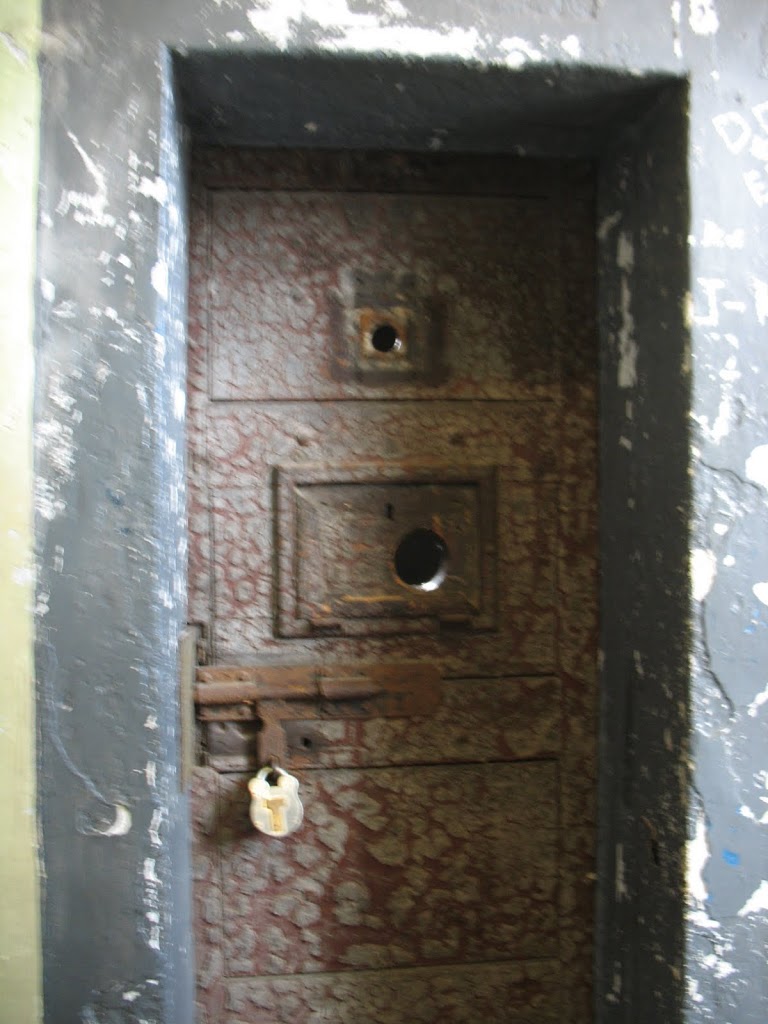
while the west wing represented one school of penal thought, the newer east wing represented another. many of the features of the newer wing are aimed at reform, rather than strict punishment. the “pan-optic” style (seen in the second photo) meant that you could see almost everything from any one point along the wall. relatively few guards could keep an eye on the large population (who were not allowed actually into the open area for any kind of recreation). the skylights were intended to draw the gaze of prisoners upwards — to remind them of the appropriate source of inspiration to repent for their crimes. the windows in the cells were located high up on the walls, and the inside of the peep hole was shaped to look like an eye: you were always being watched and you couldn’t forget where they expected you to turn for “help.”

much of Kilmainham’s notoriety stems from its famous prisoners. the leaders of the 1916 Easter Rising were held in the west wing, and executed in the hard labor yard. other nationalist prisoners, including Eamon de Valera, were held in the prison twice. following the Treaty with the British that established the Irish Free State, the Pro-Treaty forces imprisoned members of the Anti-Treaty faction, many of whom they had fought alongside during the war for independence.

after the prison was abandoned, it fell into quite a state of disrepair until it was decided to turn the facility into a museum investigating the history of the prison, and the evolution of nationalism in Ireland. the OPW now operates the facility and runs the tours. our guide was quite good and knew far more about the facility than what she covered on the tour. it was refreshing after a couple of other anemic, lamely-scripted tours of facilities steeped in history. it was also rather interesting to see her react to questions from people who had no clue about the history of the Troubles, or about the political history of relations between Ireland and Britain. after going in to some detail about how poverty and class divisions are at the root of the Troubles, one person (for whom English was not a first language) came up to ask “so, why is it that there’s a problem between Catholics and Protestants?” she took a breath, and diplomatically explained that, in fact, it’s nothing to do with religion. at all.

few more stories about Kilmainham and its prisoners in upcoming posts.

invasion

after reading Tim Pat Coogan’s history of the Troubles, I figured I had a pretty comprehensive grasp of the scope and nature of tensions in Northern Ireland in the 1960s and 1970s. of course, reading about something is nothing to visiting places that endured such turmoil or hearing people who lived through the experiences share their stories. perhaps the most suprirising thing that I learned about the Troubles, however, was that in the tumult of 1969, the Taoiseach at the time, Jack Lynch, had plans for the Republic to invade the North. there’d been massive rioting in Belfast in addition to the Battle of the Bogside. other nationalist towns, such Armagh and Newry, saw violence as well.

while I was in Drogheda, RTE One aired a special that postulated the outcome, had Jack Lynch given the call for Ireland to invade. (The Guardian comments here) I had absolutely no idea that Ireland had it’s own 60’s “Bay of Pigs” moment. the general consensus of the Irish people with whom I discussed this? it would have been a complete and total disaster for the Republic. taking on the Britsh Empire, even in its twilight? insane. and, as some critics have argued, at the time the IRA was in no position to provide tactical military support. in 1969 it was still a relatively small, guerrilla force that simply could not provide the assistance that the army of the Republic would need to succeed, should they invade the North.

obviously, Ireland chose not to invade, and history took a different turn, but the documentary was an interesting look at a possible outcome.

Siege of Derry

as promised, a bit on the Siege of Derry.

ultimately, the Glorious Revolution in England ousted Catholic James II from power in favor of Protestant William of Orange and his wife Mary (James’ daughter), but in the meantime there was a bit of a “revolution” to determine who would gain power. when William & Mary took power, James fled but eventually returned by way of Ireland, hoping to reclaim his title through garnering support of Catholic Ireland. as he approached Derry, the city “fathers” dithered about what course of action to take … until a group of apprentice boys took it upon themselves to shut the gates of the city, closing the city off from advancing Jacobite forces attempting to take the city. the city was under siege for 105 days, during which time as much as half the population living within the walls died.

eventually, the forces of William of Orange were able to breach the blockade on the River Foyle and get supplies to the defenders of the Walled City of Derry, essentially defeating the Jacobite forces to the west. the conflict wasn’t over, but the remainder of the engagements between Jacobite and Orange troops did not go well for James, whose death knell came at the Battle of the Boyne, on the River Boyne north of Dublin and whose valley is home to many more monuments spanning millennium.

every year, the Protestants of Derry celebrate the efforts of the Apprentice Boys, who closed the gates of Derry to the adavancing Jacobite forces, with marches similar to those of the Orange Order elsewhere in the north of Ireland. these marches do not sit well with the Catholic community (and led to more than one confrontation during the Troubles); they go along the city walls and are highly visible from the Bogside and other Catholic areas to the west of the city walls. these marches were a threatening reminder of repression and centuries of abuse and disenfranchisement. as previously mentioned, the Apprentice Boys march in 1969 led directly to the Battle of the Bogside and establishment of Free Derry. the marches continue, though the scale of violence seen in 1969 went unrepeated (at least during the marching season). doesn’t mean the marches aren’t crass or designed to be threatening.

a plant matter: peat

peat. that rich loamy stuff that carpets much of Ireland. used for heating and, yes, gives off a particular scent when burned. Connemara is covered by blanket peat bogs, and driving up from Clifden bogs stretched in all directions in various stages of harvest. cutting of peat for fuel (called ‘turf’ once cut) has changed the landscape of Ireland. hiking in Connemara National Park (one of six national parks in Ireland) gave me an opportunity to see the stuff up close. there are two types of bogs: blanket and raised, the former prevalent along the more mountainous coastal regions in the west, the latter in the valleys of the middle of the island. it’s easier to harvest from raised bogs, and so consequently the bogs in central Ireland have been more greatly affected by turf cutting. the blanket bogs aren’t as deep, so they’ve fared somewhat better. while I was hiking, the loam looked so rich and inviting that I felt compelled to pry off a piece and really get my hands on it. the stuff is rich: it feels rich and smells rich and i suspect that if I’d been possessed to take a bite, it would also have tasted rich..

turf is cut with a special kind of spade in the form of bricks. usually they’re hacked from the bog in rows, cutting downward into the face of the bog, depleting the bog six-inches deep at a shot. once it’s cut, it’s left to dry on the bog for a week, before being re-stacked for further drying. in the second photo, you can make out where turf has been cut from the bog. there’s been quite some destruction to the size of bogs, particularly in the late 20th century. cutting of turf increased in the 1980s and, because they are made up of compressed plant matter, they do not replenish themselves nearly as quickly as they are harvested. if left long enough, and compressed enough, it can turn into coal.

I wish that I could remember some of the figures they had in the visitor’s centre at Connemara National Park, about how much peat the bogs lost in the 20th century, how much of Ireland is covered in peat, and all the other interesting history-of-peat tidbits they had. I went into the visitor’s center after my hike (as I did the trail in reverse of the “normal” direction) and got roped in to take one of many visitor’s surveys about my experience. in any case, if you’re ever in Ireland, then I recommend Connemara. and if you’re ever in Connemara, I recommend the National Park.

resistance and Free Derry

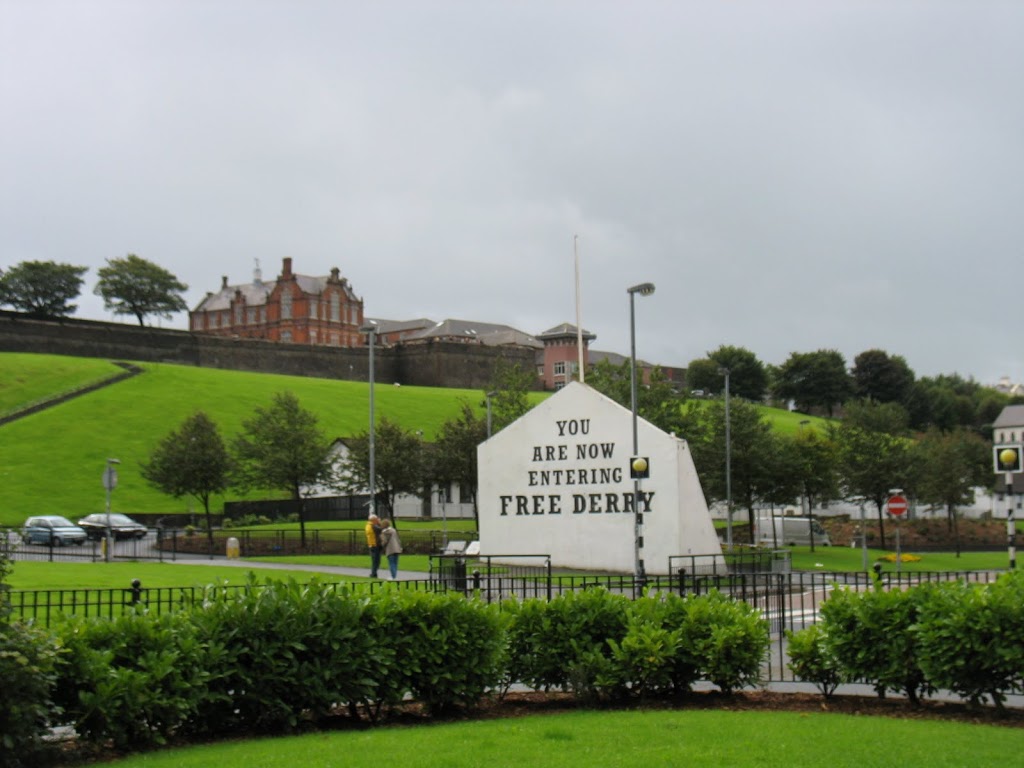
following the Battle of the Bogside, residents took it upon themselves to maintain and defend their community; the official government certainly wasn’t doing anything to their benefit. the name “Free Derry” comes from a tag written on a gable wall by a resident walking past in January 1969, when organized resistance to incursions by the police force first developed in earnest. the phrase was seized upon and came to symbolize resistance to external policing forces (both local and British). it was formalized on that gable wall, painted and repainted in letters large enough to see from a distance. when the row houses extending from this gable were torn down, the community requested that this wall remain as a memorial to Free Derry and events that occurred in Derry during the Troubles.

during a three year period, residents organized police patrols, issued permits to trade in the community (for those making deliveries from outside Free Derry), and provided services that the local government had failed to sufficiently extend to the Catholic community; it was a no-go area protected by both the Official and Provisional IRA. despite best efforts, however, Free Derry came to an end with Operation Motorman in July 1972, when British troops stormed the Bogside (as well as no-go areas in Belfast) (more on that to come, I think).

(an aside: the relationship between the Official and Provisional IRA in Derry was not nearly as contentious as elsewhere in the North. neither group had control over barricades, and the Provisionals had few weapons. also, unlike in Belfast where Provisional bombing campaigns killed civilians in addition to causing structural and economic damage, that in Derry is noted for avoiding death or injury to innocent civilians. as Eamonn McCann wrote, “the Derry Provos, under Martin McGuinness [now Deputy First Minister for Northern Ireland under the power-sharing government], had managed to bomb the city centre until it looked as if it had been hit from the air without causing any civilian casualties.”)

Operation Motorman

the end of Free Derry came with Operation Motorman on 31 July 1972. after three years of keeping external police forces out of Free Derry (as well as areas of Belfast), at 4am the British Army launched a sweep of no-go areas. some 20,000 troops swept through the area, dismantling barricades with bulldozers and hauling people out of their houses. because of the superiority of firepower of the British, neither wing of the IRA offered resistance and Free Derry came to an end.
http://upload.wikimedia.org/wikipedia/commons/a/af/Derry_mural_6.jpg

Battle of the Bogside

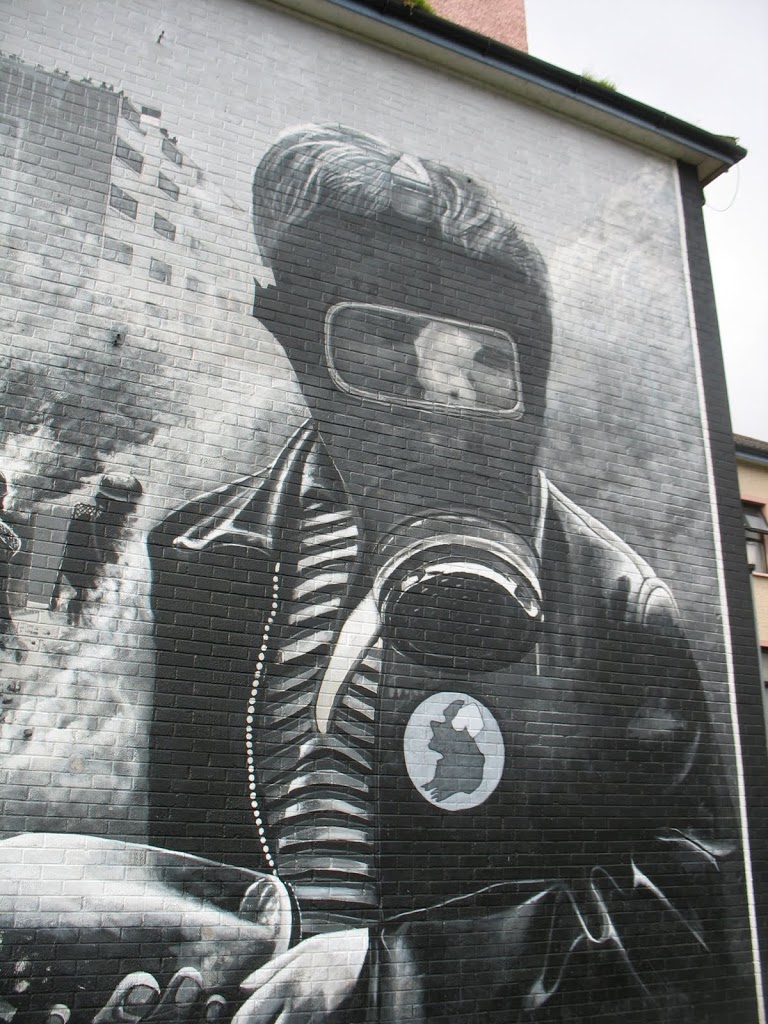
the other major, catalyzing event to occur in Derry was the Battle of the Bogside. i know i haven’t explained the nature of Bogside yet, but soon. tomorrow, maybe. for now, we’ll stick to this mural.

in August 1969, tensions were even higher than normal when the Apprentice Boys held their annual march, to commemorate the Protestant victory in the Siege of Derry (again, more on that in a later post). the Catholic community protested the march, confronting the Protestant gathering and ultimately throwing stones and what have you at one another. the police chased the Catholics into the Bogside, where they set up defenses and barricades.

in the mural, over the Rioter’s right shoulder you can see the Rossville Flats, which stood on Rossville Street. in a nutshell, they were shit flats, built to keep Catholics segregated in the Bogside and, because of insane property-owning-electoral laws, served to disenfranchise the Catholic population on a massive scale. during conflict with police, however, it became apparent that it was a pretty good location for launching attacks on police and troops down in the road. too high for their weaponry to reach and affording a good vantage point for lobbing stones and petrol bombs.

the rioting lasted for three days. in the end, British troops were called in to calm the situation; longstanding tensions between the Protestant-dominated Royal Ulster Constabulary meant that those defending Bogside would not let up if it meant letting up on the RUC. the B-Specials were called up to enter the fray, which would certainly only serve to escalate the situation. in comparison to facing down the RUC bolstered by the B-Specials, in late 1969 the British troops were seen as a neutral force, one that didnt’ necessarily have baggage or history with the Bogside community, and who might be reasonable in their policing, at least. as history attests, that attitude didn’t last. by this point, the Bogside was thoroughly mobilized; returning to the status quo, impossible. in fact, the previous month, the community set up the Derry Citizens’ Defence Association, to protect against oppression and aggression from the local police force. following the Battle of the Bogside, the DCDA took over control of the Bogside and, until Operation Motorman three years later, neither local police nor British troops were able to penetrate beyond the Free Derry wall.

Bloody Sunday

Derry and Belfast are very different cities and it seems a shame that people who visit the North might only go for one or the other, but not both. perhaps because of its size, or because Stormont is located there, or because the unionist and republican communities abut one another so closely, or because economic conditions are still perilous for many as people continue to migrate to Belfast from the country, but things in Belfast felt more contentious than in Derry. maybe it’s just my perception, but maybe, because Derry’s a much smaller city it’s had to confront tensions more head-on, maybe there’s a vocal enough republican contingent, and a strong enough tradition of resistance that the horrors of the Troubles had to be more fully addressed. or maybe I developed that impression because I stayed on the western side of the River Foyle and took a tour of Free Derry, but not of the Walled City (blasted head cold!) 

in any case, unlike Belfast which suffered all manner of bombings and terrorist attacks with some regularity, there’s one event that epitomizes the horror of the Troubles in Derry: Bloody Sunday. in order to understand Bloody Sunday, one has to also appreciate the history of Derry: plantation, siege, settlement of Bogside, discrimination against Catholics, and ultimate involvement of British troops. basically, it is a hot mess, and i think i’ll save a greater explanation of the history for a later post and stick to Bloody Sunday for the moment.

on 30 January 1972, residents of the Bogside planned a march to the Guildhall to protest internment, but because of blockades diverted the route towards the Free Derry corner. as the marchers wanted to avoid violence, they elicited an agreement from the IRA that the organization would stay away. some believe that it was because of the absence of the IRA that the British troops felt secure in using excessive force. according to our guide, who grew up in Bogside during the period, it was routine for people to attack the British forces stationed at the entrance to the Bogside. riots were a common, if not daily, occurrence, and their length and ferocity depended a lot on the weather. if it was cold and pissing down rain, protests might last ten minutes. if some event invigorated people and the weather was conducive, they could last for hours. essentially, it seems there were standard rules of engagement between rioters and the troops. for whatever reason, those rules vanished on Bloody Sunday. the troops responded. with vigor. whether it was because they knew the IRA was not present to respond (as our guide suggested), or for some other unknown reason (firmly established in reality or concocted by those higher up the chain of command) has yet to be established.

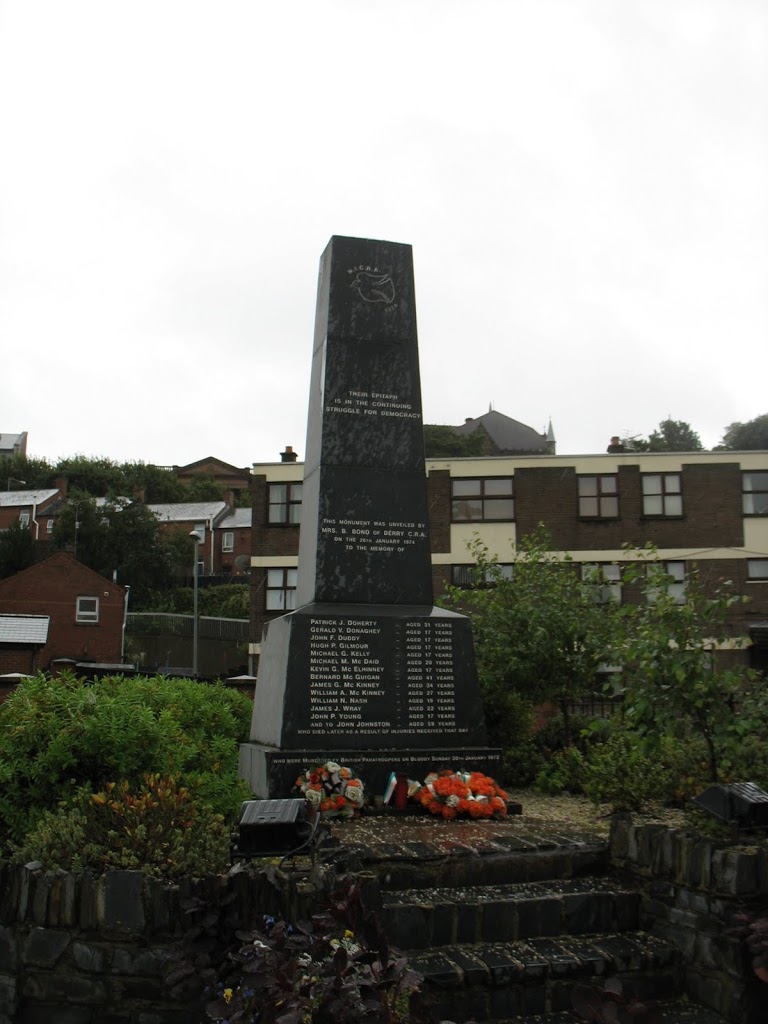
in the end, fourteen people died (thirteen killed that day, and one who died later as a result of injuries). some of them were fleeing, one had his hands up in surrender, and none of them posed a real threat to the troops bearing down on the area. despite official claims, none of the victims carried weapons of any kind (though one had bombs planted on him. this lie was particularly egregious as the bullet that killed him passed through a pocket in which a bomb was later planted; it would have been a much different mess to clean up had the bullet actually passed through the pocket-with-bomb.) the British assault was not a chaotic sweep of gunfire that caught civilians in the crossfire: it was a drawn-out episode in which people were gunned down methodically.

Bloody Sunday served to bolster the ranks of the IRA and further enraged the public in opposition to the occupation by British troops. seven months later, however, the British launched Operation Motorman, a massive strike designed to retake republican strongholds in Belfast and Derry. in the end, the no-go area of Free Derry was swept away by British troops and both arms of the IRA, acknowledging that they were wholly unmatched to oppose the thousands of troops, tanks, and armored cars involved in the sweep offered no resistance.

murals of Bogside

the location that I perhaps enjoyed the most in all of my travels in Ireland was Derry. which, legally, isn’t a part of the Republic at the moment, though most of the people I spoke to south of the border don’t think in those terms. in one place, we went through a brochure produced by the Northern Ireland tourism board and crossed the “London” that preceeded Derry wherever we could find it.

the city of Derry is known for its walls. i’ll talk about the old walls in a later post, but first, some on the “other” walls — those of the Bogside. as in Belfast, Derry has murals commemorating events of the Troubles. but whereas the murals of Belfast often change to reflect current political realities, the murals of Bogside were commissioned and created by a group of artists. there are twelve in all, taking up the ends of row houses throughout the Bogside. i didn’t take pictures of all of them, but i’ll share the ones that i have, beginning with my favorite:

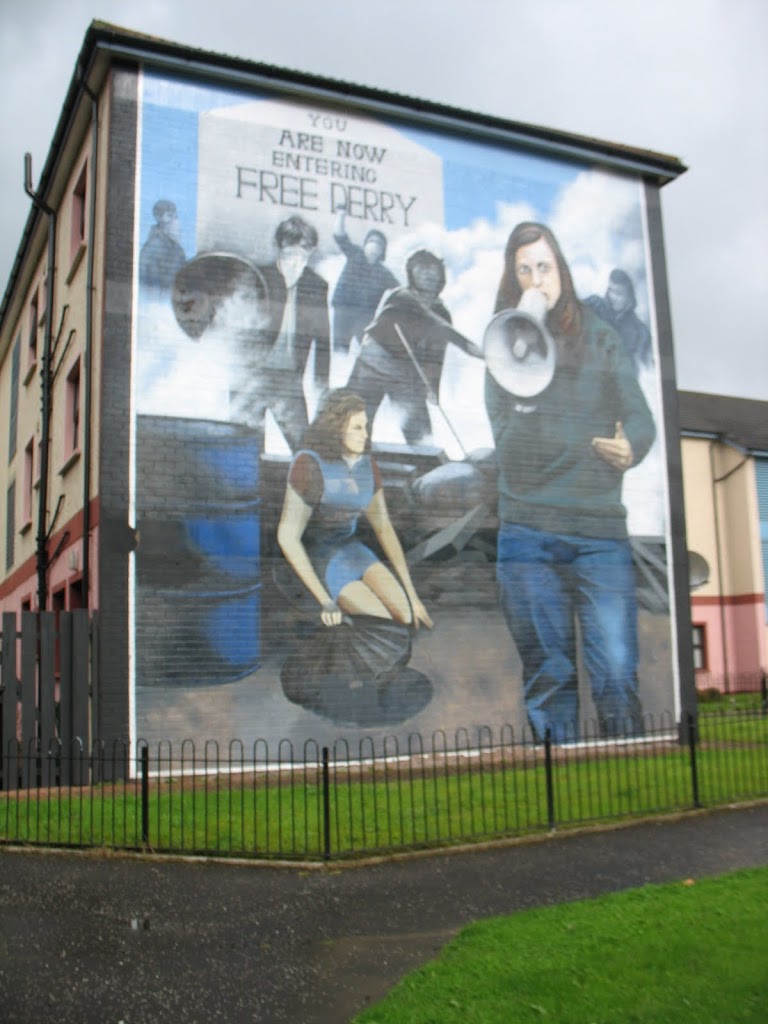
this one, Bernadette, depicts the Battle of the Bogside and features Bernadette Devlin (more on the Battle later). Bernadette was a student at the university in 1968, when tensions in the North were growing exponentially. she became a prominent voice in the student movement and was elected to Parliament at the age of 21, the youngest woman ever elected MP. rather than follow the tradition of abstentionism in protest of the treatment of Catholics in the North, Bernadette chose to take her seat at Westminster and raised hell. as seen in the mural, she supported residents during the Battle of the Bogside and, following Bloody Sunday, was temporarily suspended from Parliament (she punched the Home Office Secretary for claiming the British Army fired in self-defense).

in the mural, there are a couple of things of note. first, the residents at this point were not heavily armed. they used stones and basic petrol bombs to attack the incoming forces. it seems that neither side was ever very well prepared for the confrontations; sometimes that meant a deficiency in weaponry, inadequate defensive material, or an abject lack of information about conditions. resistance was gritty and sprung from frustration and survival instincts. second, during confrontations, women would keep watch and bang trash can lids on the pavement to alert others of police or other troops. third (of which more later), the Free Derry Corner was the locus for much of the resistance to British incursion in Derry. though the row of houses that originally stood on the site has been demolished, residents requested that the end wall remain as a reminder of what has transpired.

Galway Cathedral

officially named the Cathedral of Our Lady Assumed into Heaven and St. Nicholas, construction on the Galway Cathedral began in 1958 and it was consecrated in 1965. the pews are mahogany and hold up to 2,000 worshipers in a service. the floor is green Connemara marble, and the “acoustically correct” cedar ceiling comes from Canada. one of the stained glass windows depicts the ‘modern’ holy family — Mary is knitting while Jesus and Joseph make a cup of tea.

the cathedral stands on land once occupied by a prison. the courthouse lies just over the bridge and once sentences were handed down, the convicted were merely shunted across the river and locked up. imagine the thought of tearing down a prison in the U.S. and replacing it with a church!