Jackson Square

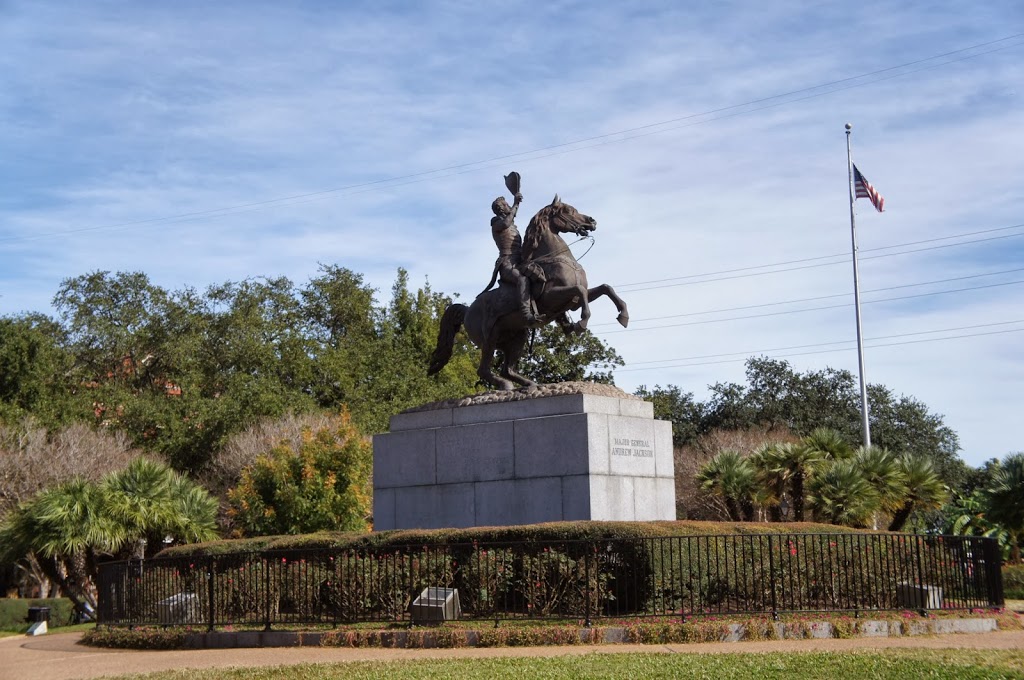
while one of the most popular locations in the French Quarter, I had no idea I was looking at Jackson Square when I first saw it. it was just “off to the left” while we were waiting to taste our first beignets. it’s most prominent feature is Andrew Jackson, hero of the Battle of New Orleans and later 7th President of the United States, rearing up on his trusty steed. it is one of four identical statues of Jackson, the other three residing in D.C., Nashville, and Jacksonville.

in the colonial period, the space between St. Patrick Cathedral and the river was the Place d’Armes/Plaza de Armas and served as a public space, military parade ground, and open-air market for the burgeoning city. it also served as a place for executions in the rowdier days of the colony, including those of the German Coast Slave Uprising of 1811.

later in the 19th century the Baroness Micaela Pontalba helped transform the square into a garden, lobbing for and financing the transformation into a park. the new design included pathways, benches, fountains, and an iron fence along the outside, with her namesake buildings facing the park from across St. Ann and St. Peter streets. the statue was dedicated in 1856, and a plaque proclaiming that “The Union Must and Shall be Preserved” added during the Civil War by Union General Benjamin Butler during the occupation of the city.

today, now that three of the adjacent streets have been made into pedestrian malls, all manner of artists, performers, and fortune and tarot readers entice tourists. during the time we were around the Square I saw perhaps a half-dozen musical performers of all varieties. while in the Presbytere, I thought the exhibition’s soundtrack had gotten turned up overwhelmingly loud … but it turned out to be the brass band in front of the building!
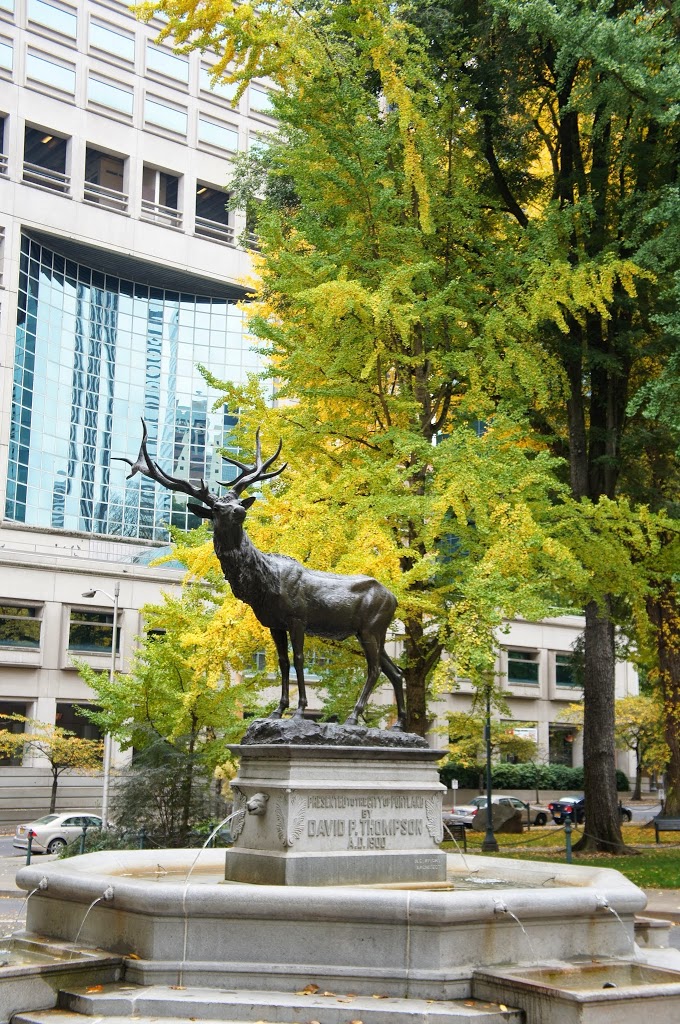
Thompson Elk

one of the more interesting things in the Plaza Blocks is the statue and fountain that stand smack in the middle of Main Street. it was donated by David P. Thompson, who, among other notable positions, served as Mayor of Portland from 1879-82. he also served in the Oregon State Senate, in the First Oregon Cavalry during the Civil War, and as U.S. Minister to the Ottoman empire (for a year at the end of the 19th century. back in Oregon, he also served as regent of the University of Oregon, president of the Oregon Humane Society and first president of the Portland Public Library.

the Elk was commissioned of Roland Hinton Perry, who completed many notable works around the turn of the twentieth century. born in New York, Perry studied sculpture at several Parisian institutions in the 1890s. upon returning to the United States, his commissions included a series of bas-reliefs for the Library of Congress, a potential design for the statue atop the Pennsylvania Capitol building, a statue of Benjamin Rush in Washington and General George Greene at Gettysburg, and a pair of lions on the Connecticut Avenue Bridge in D.C.

Bienville and the founding of New Orleans

this year, our Homecoming tradition took us for the first time to a city where none of us have ever lived, and two-thirds of us had never been: the Crescent City, the Big Easy, home of the cocktail, voodoo, jazz, and beignets — New Orleans.

we were up early the first morning to explore the city, heading first to the French Quarter the oldest and possibly most atmospheric of the cities sections. initially, I was taken aback by how little of the city’s early history I knew — first settled by the French, then taken over by the Spanish and returned to the French only to be sold to the fledgling United States. up from the Louisiana Purchase I have a vague understanding of how things operated, but I was delighted to discover a much more layered and rich history than I’d ever anticipated.

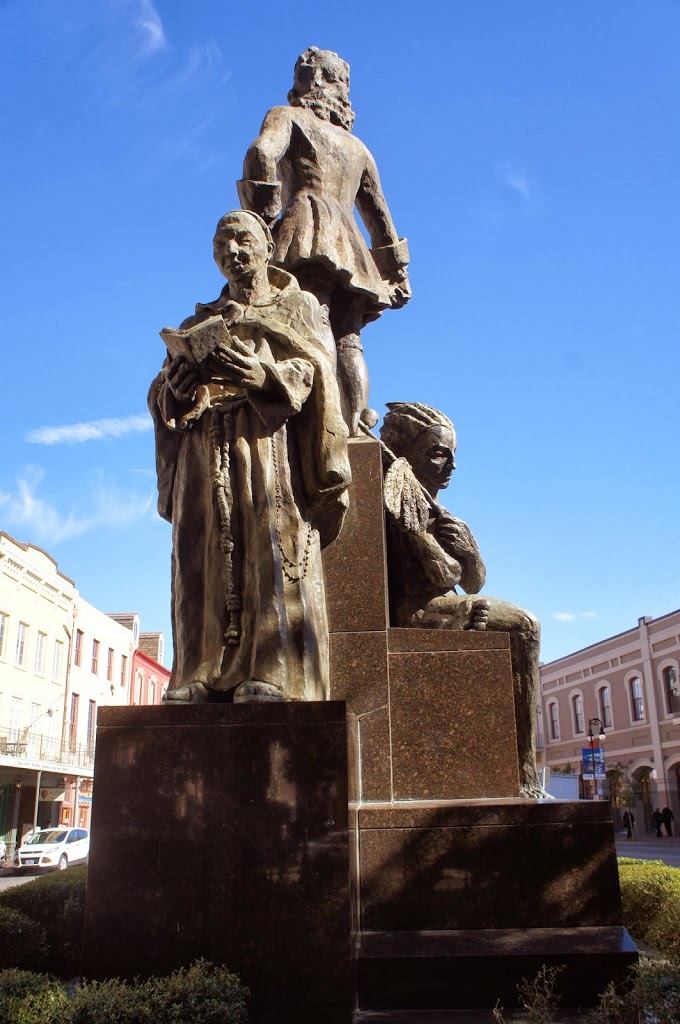
one of the first plaza statues we encountered was of Bienville, one of the founders of New Orleans and early governor of the French colony. born in Montreal, he was appointed to the position for the first time in 1701 and established several settlements, including a deep water port at Dauphine Island, what is now Mobile, Alabama, and ultimately New Orleans. the slight elevation made it far more practical than other sites along the flood-prone river and delta and was convenient to important trading positions. with permission from the company directors, he established New Orleans in 1718 and the heart of it — what is now known as the the Vieux Carre or French Quarter — was drawn up between 1720-21. the proposed grid pattern was largely overlooked by settlers initially, but when a hurricane flattened most of the existing structures in 1722, the new pattern went into effect, as we see it today. it became capital of the new colony, named for the Duc d’Orleans, in 1723.

the land had been inhabited for thousands of years by native peoples and, generally, the original inhabitants welcomed and aided early settlers, such as French trappers and traders traversing the Mississippi River. Bienville was known for his cordial relations with Native Americans, one of few early governors who could communicate without the use of an interpreter and, moreover, willing to aid local tribes against opposition tribes. many of the settlers were unsavory types and the governor complained frequently in his letters back to the central government. his relationship with administrators of the Company of the Indies, which controlled the colony, was fractious and resulted in him being recalled to France in 1725. he returned some 8 years later and severed as governor officially and focused on fortifying the settlement. all told, he served 30 years as governor over a 42 year period and retired to live in Paris for more than twenty years.

Lownsdale & Chapman Plazas


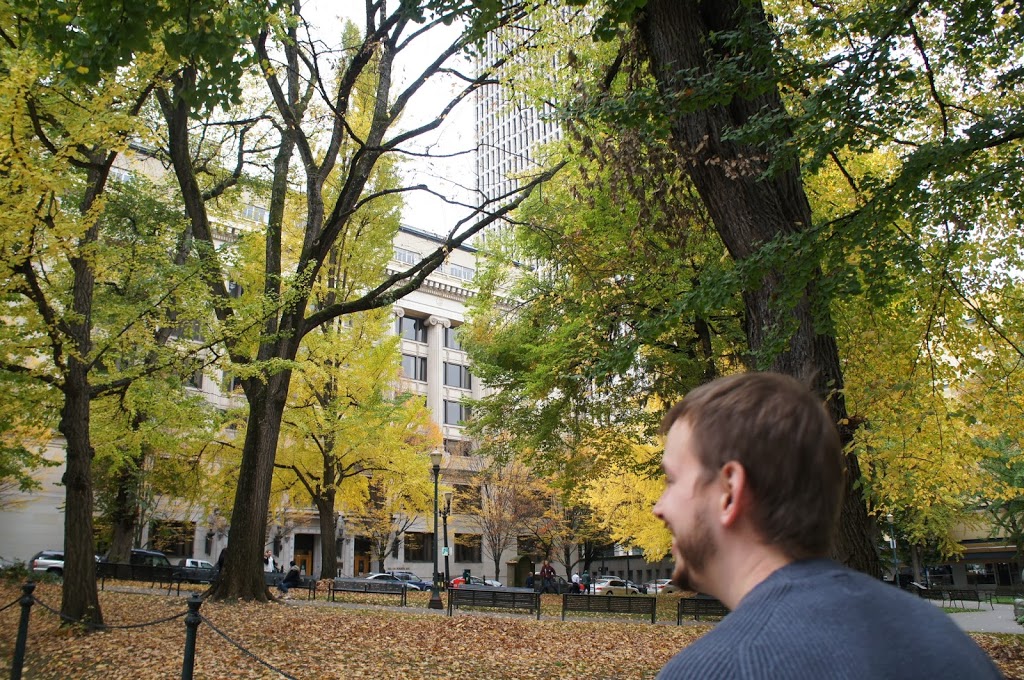
without any grand plans for our time in Portland, beyond seeing friends and family and a drive down to Bend, we found ourselves out wandering around downtown, enjoying the spectacular fall weather, shuffling our feet through crisp and freshly fallen leaves. one of the first places we walked through was a pair of plazas flanking the Thomson Elk statue, which stands smack in the middle of Southwest Main Street. the plazas are named for Daniel Lownsdale and William Chapman and host towering trees, the likes of which I haven’t seen in a city of substantial size in recent memory.

Lownsdale arrived in Oregon from Kentucky before 1845 and became a member of the provisional legislature in 1846. he established the city’s first tannery on its northwest side and purchased part of what became downtown Portland from one of the city’s founders (Francis Pettygrove) in 1848. he was influential in helping determine the current layout of Portland — with small blocks of 200 feet by 64 feet with contiguous park blocks such as the one that now bears his name.

Lownsdale Plaza plaza is home to a monument to the Spanish-American War and two howitzers found at Fort Sumter donated by author Henry Dosch. Dosch claimed the howitzers had been used by both sides during the Civil War.

the adjoining park is named in honor of William Chapman, another early settler of Portland with a long political career. he settled in Portland in the late 1840s after traveling from Iowa, where he’d served as a Congressional Delegate for the Iowa Territory, by way of the Oregon Trail. he moved around the region, with a successful stint in California during the 1848 gold rush. he served in the first Territorial Legislature and, when the session ended, convinced Thomas Dyer to move from San Francisco to Portland to establish a newspaper. The Oregonian is the oldest continuously publishing newspaper on the west coast, predating the founding of Portland. he purchased land from Lownsdale and built a home on the site of what is now the Multnoma County Courthouse, where he practiced law for many years even as he moved around the state – to raise cattle in Southern Oregon, serve as lieutenant colonel of the militia during the Rogue River War of 1855-56, and serve as surveyor general from 1857-61 (when he resigned due to opposition of Lincoln’s election). in his later years, while continuing to practice law, he fought to get Portland connected to the Union Pacific transcontinental railroad to ensure the city would continue to grow and remain connected to the rest of the coast and country. (his proposed line was never built.) in 1870, he sold the land now occupied by the plazas that bear his and Lownsdale’s names to the city of Portland.

Book of Kells

my first trip to Ireland, I decided not to stand in line to see the Book of Kells, which is probably for the best — at that point my knowledge of Irish history was rooted solidly in the twentieth century. having learned more about it and other illuminated manuscripts in the intervening years (in addition to seeing the delightful film of the same name), this time I was keen to make the trip to Trinity.

scholars generally agree that the Book originated in a monastery founded by St Colum Cille located on an island off the coast of Scotland. for quite some time, tradition held that St. Columba himself penned the text, though recent scholarship discredits that claim, dating the composition of the Book to more than two centuries after Columba’s death. some suggest the Book was created, likely by three primary authors, to honor the saint on the 200th anniversary of his death.

after a Viking raid in the early 9th century on the Isle of Ione, the monks relocated to a new monastery in Kells, from which the Book derives its name. creation of the Book dates to around this time, though no definitive evidence exists to indicate whether the Book was produced entirely at Kells, Ione, or at both. the printing of the text may have occurred at one, the illumination at another; it may have been done all at Kells, all at Ione, or even wholly the north of England or Scotland.

the first written reference to the text comes from the early 11th century, when the Annals of Ulster made reference to the theft of a great Gospel of Columba by Viking raiders. the volume was recovered (without its bejeweled, golden cover) some months later under a bit of sod. it remained at Kells after the dissolution of the Abbey, which became a parish church, until Cromwell’s men quartered there in the 1650s. the governor of the town thought it best to send the book to Dublin for safekeeping. in 1661 the bishop of Meath presented the manuscript to Trinity College permanently and it has remained there, with rare exceptions of loans, since. it went on display to the public in the 19th century and nowadays you see two different pages when you visit — one illuminated and one of standard text.

Ireland recap posts

on my first trip to Ireland, I wrote about several things we saw on this more recent trip. I may yet be moved to write about certain of these things this time, but feel free to read back (and marvel at my writing style!)

Dick Mack’s in Dingle
Dick Mack’s take two
Dunbeg Ring Fort
Gallarus Oratory
Fuchsia
St. Stephen’s Green
Temple Bar

1916
Countess Markiewicz
Eamon de Valera
Easter Rising 1916
Joseph Plunkett & Grace Gifford
Kilmainham Gaol

Dunquin

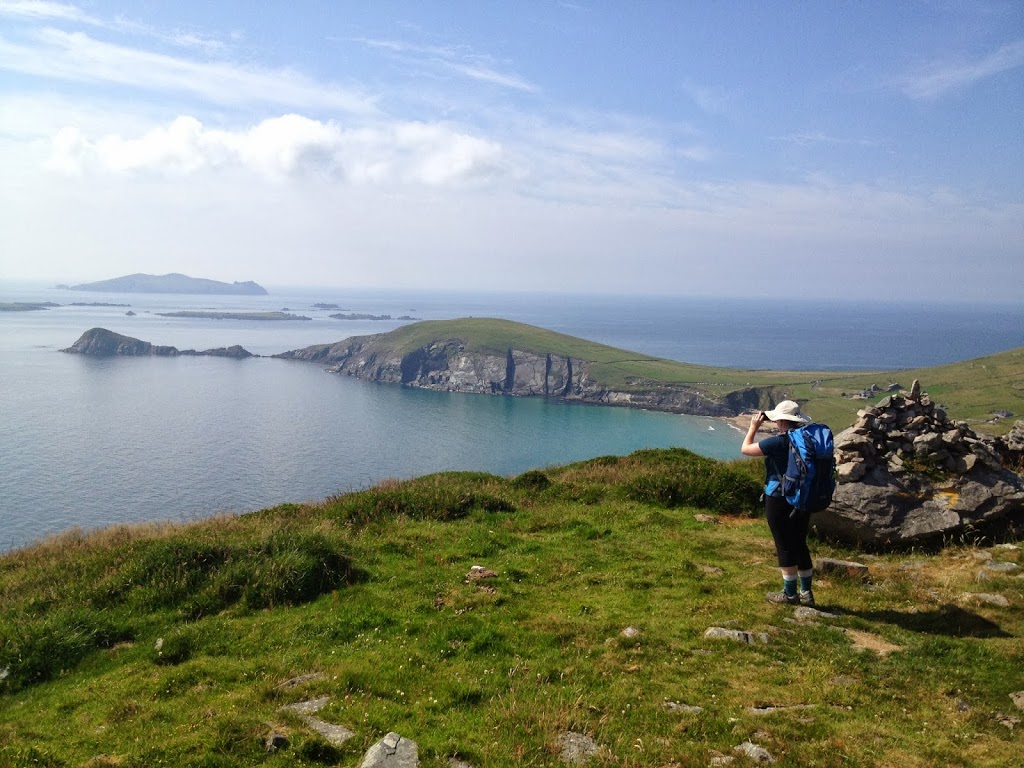
Dún Chaoin is the western most village in Ireland (the parish, which includes the Blasket Islands, is sometimes referred to as the next parish to America) and afforded us with a welcome opportunity to take a break from hiking the Dingle Way. compared with many of the towns on the outward portion of our hike, the town didn’t offer much in the way of conveniences; it was a good prelude for the next several days of hiking inland.

options for dinner when we arrived after a long and physically demanding (and breathtakingly beautiful) day of hiking we limited to: purchasing & cooking pasta in the hostel kitchen; hiking to the next town, some 30 minutes further along the road; or hoping the only pub in town still had makings for white-bread sandwiches. we opted for choice number three and stumbled down the hill to Kruger’s Bar, which was a nice change from the crowded and touristy a pubs in Dingle town. a younger woman was tending bar, chatting with a couple of regulars and a grandmotherly proprietor type, who contributed to the conversation exclusively in Gaelic. she may have even been on hand the evening in 1971 when the Campaign for the Revitalization of Ale (promoting real ale, real cider, and the traditional pub) was founded in the same room (now known as the Campaign for Real Ale, the largest single-issue consumer group in the UK).

we ordered our pints and white-bread sandwiches — ham & cheese for Andy, cheese & tomatoes for me — and settled down by a corner window with views of the water. not a lot of competition for seating (all those people who just drive around the Dingle Peninsula, me of several years ago included, don’t know what they’re missing). the grandmotherly woman got up and shuffled back into the kitchen to make our sandwiches which, frankly, were the the best white-bread sandwiches you could ever eat not just because we were hungry but because such a character prepared them for us.

while we waited, I considered the portraits tacked up along the walls — snaps from when film crews for “Ryan’s Daughter” and “Far & Away” visited Dunquin in the late 1960s and early 1990s, respectively. not much of a draw from them now, but certainly potent in their day. plan to watch both to see if anything looks familiar, or if it’s all been made into generic “Ireland” with a coastal flavor.

Trinity College Long Room

when I visited Ireland previously, I hadn’t any particular interest in queuing up to see the Book of Kells at Trinity College. it seemed too much like trying to see the Mona Lisa at the Louvre — lots of craning and waiting to discover that, while impressive, it really is much smaller than you’d think and the crowds prevent you from spending any satisfying length of time studying it. upon reflection (and after viewing the animated film of the same name), however, I rather regretted that decision and put it on my list of sights for any future trip to Dublin.

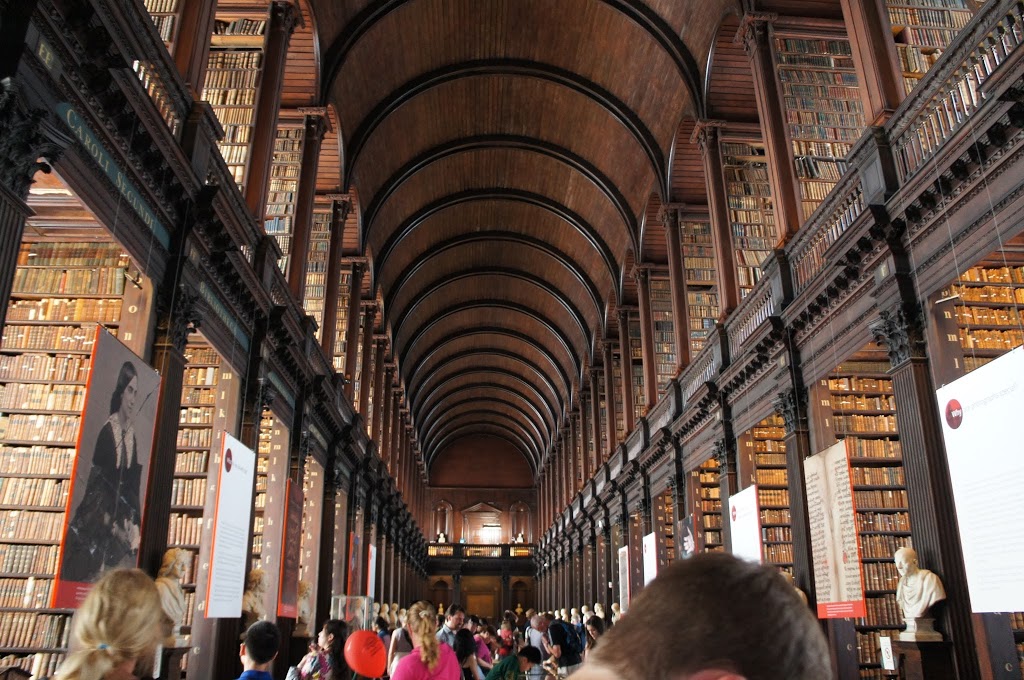
and adding it to my list was worth it if for no other reason than it granted me access to see the Long Room situated above. a byproduct of my love of history, I am also partial to unique or interesting libraries that have some interesting artifacts or stories behind them (I always loved Seymour Library for that very reason). both the space and the exhibit in the Old Library at Trinity did not disappoint.

stretching some 65 meters long and originally constructed between 1712 and 1732, the Old Library at Trinity started out with a boring plaster ceiling and books filling only the lower shelves. in 1801, however, it became the “copyright library” (or legal repository, like the Library of Congress) for all materials published in Ireland (and , uniquely, the United Kingdom) and it quickly exhausted its existing space. in 1860 the roof was raised to allow for constructed of the vaulted ceiling and second level of shelving.

the Old Library now holds some 200,000 books, some of the oldest held by the university, including some on display when we visited for an exhibition on preservation and conservation techniques. on display were books bound in leather and with wood; written on clay, papyrus, paper, vellum; texts in ancient languages, modern languages; illuminated manuscripts (like their more famous cousins downstairs) and hand-written scientific observations, or notes scribbled in a random on-hand journal; some decades old, some centuries old. just beside the entry door is one of the few remaining copies of the Proclamation of the Irish Republic read out by Pádraig Pearse in front of the General Post Office in 24 April 1916, something it seemed most people brushed past, just as a fair number trundled down the Long Room without looking at the rare manuscripts on display, their mission of seeing the Book of Kells accomplished.

the only downside to such an historic and impressive building — it was not built to compensate for the weather on the day we visited. as with each day on the Dingle Peninsula, our day out in Dublin proved unseasonably warm and without air conditioning or the ability to open any of the windows on the first floor to get a cross-breeze going, the informative exhibit on the Book of Kells was a trifle stuffy. the room housing the Book was, understandably, closely climate controlled and a welcome change after reading all the informational material.

Garfinny Bridge

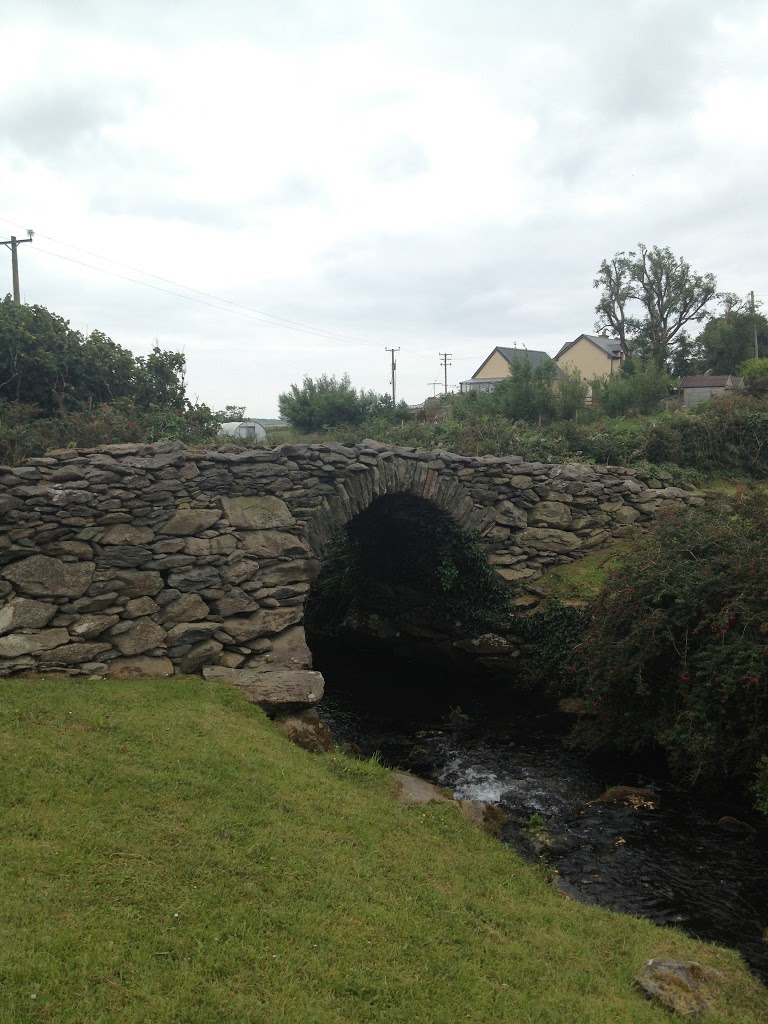
while our guide material made reference to the Garfinny Bridge, it still came as a pleasant surprise. (partly due to the fact that we hadn’t seen a way marker in some time and I’d begun to fear we might have missed a turn.) situated “just” outside of Dingle (if you are in a car … still about an hour if you’re on foot), sources claim it is the oldest surviving stone bridge in all of Ireland. it dates from sometime in the 16th century and, like most bridges of its era, was constructed without mortar — just radial stones and clay to secure everything using a corbelling technique. the apex of the arch stands about 3 meters over the river surface.

the informational plaque indicates that the troops of Lord Deputy Arthur Grey may have crossed this bridge on their way to massacre some 600 Irish, Italian and Spanish rebels at Smerwick Bay. Grey, along with some 6,000 recruited soldiers, had been sent to Ireland in 1580 as Lord Deputy to put down the Second Desmond Rebellion. he was largely successful in stifling the rebellion, but even at the time some of his actions were questioned, such as the massacre at Smerwick. (he also executed a former chief justice for suspicion that the man supported the rebellion.) many say he promised the rebels safety if they surrendered their weapons and position, a promise that he soon broke, giving rise to the term “Grey’s faith.”

by the 19th century, the bridge had begun to collapse and people opted to ford the river a bit upstream. in the late 20th century, the bridge was restored to its current condition, which found us crossing the river by it rather than the nearby modern road.

Minard Castle

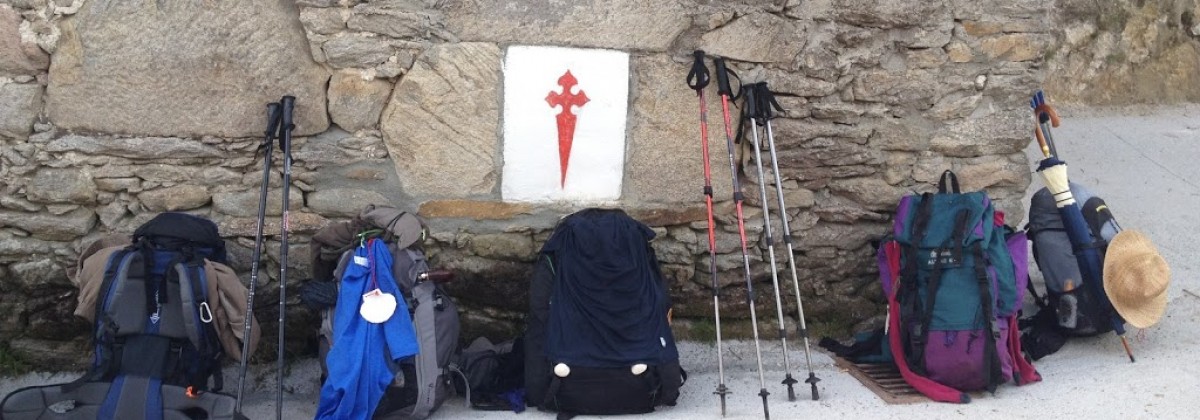
one thing we kept realizing during the course of our hike was how much more spectacular the terrain proved on a daily basis, compared to Spain. we certainly saw some incredible, remarkable, breathtaking things in Spain, but there were also a lot of long, dull, unremarkable days. the route of the Camino was about getting from point a to b to c to d to z, more with a mind to the least arduous and most expeditious route. even if you set out on a pilgrimage with an eye to commune with a higher power or to explore and express your faith in religion, you don’t necessarily want that to take longer than it absolutely has to.

hiking the Dingle Way was completely different. the point of the hike is to enjoy it, to see the views, to take it all in. you’re walking in a loop! starting out you know you’ll end up in precisely the same place (quite literally, in our case). that makes the unexpected discoveries that pop up along the route all the more exciting — you’re supposed to be finding, seeing, and enjoying these things and when there’s no pressure to get to your destination at a certain time (*ahem* securing a bed in an albergue), you can take longer to enjoy them.

one of those places was Minard Castle, perched on a hill a few kilometers outside of Anascaul on an inlet overlooking the Iveragh peninsula

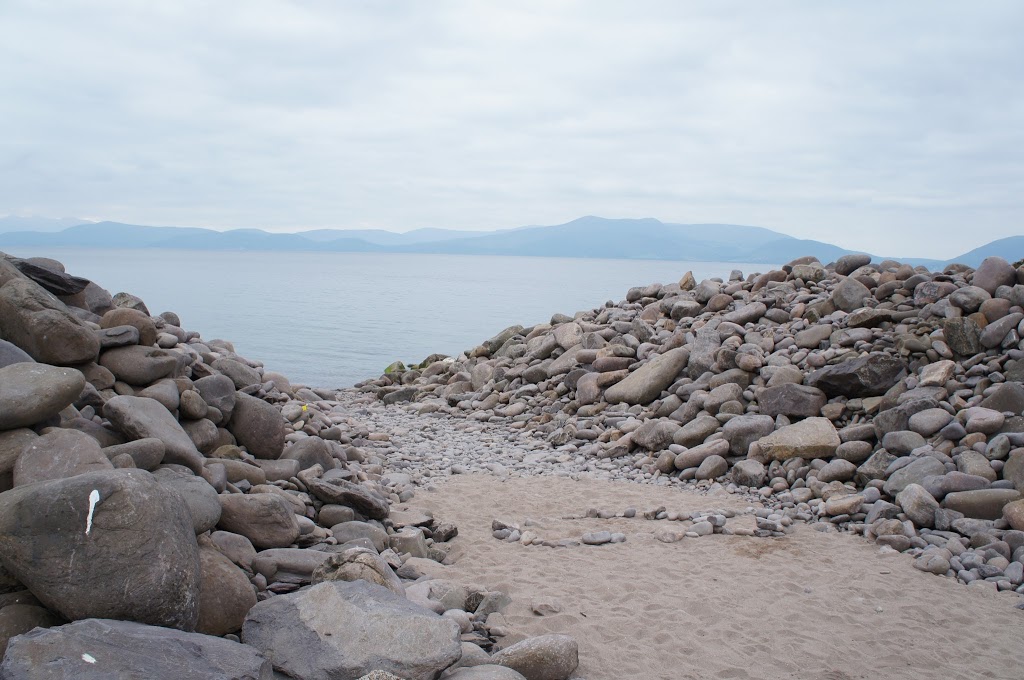
a and a remarkable large-stone beach. it was built during the 16th century by the Fitzgeralds, merchants and traders who controlled much of the region beginning in the fourteenth century, of sandstone and mortar. remains of three stories remain today, though a fourth story or attic space likely existed at one point. in the 17th century, Cromwellian forces detonated charges at the base of a corner, damaging but not destroying the building. subsequently, all the residents were killed in skirmishes with Cromwellian forces and that, coupled with the damage done by the explosion, meant no one made an effort to rehabilitate the structure. today it’s stands, technically out-of-bounds and unstable, though next to such a picturesque beach, it’s hard to imagine that everyone stays out.