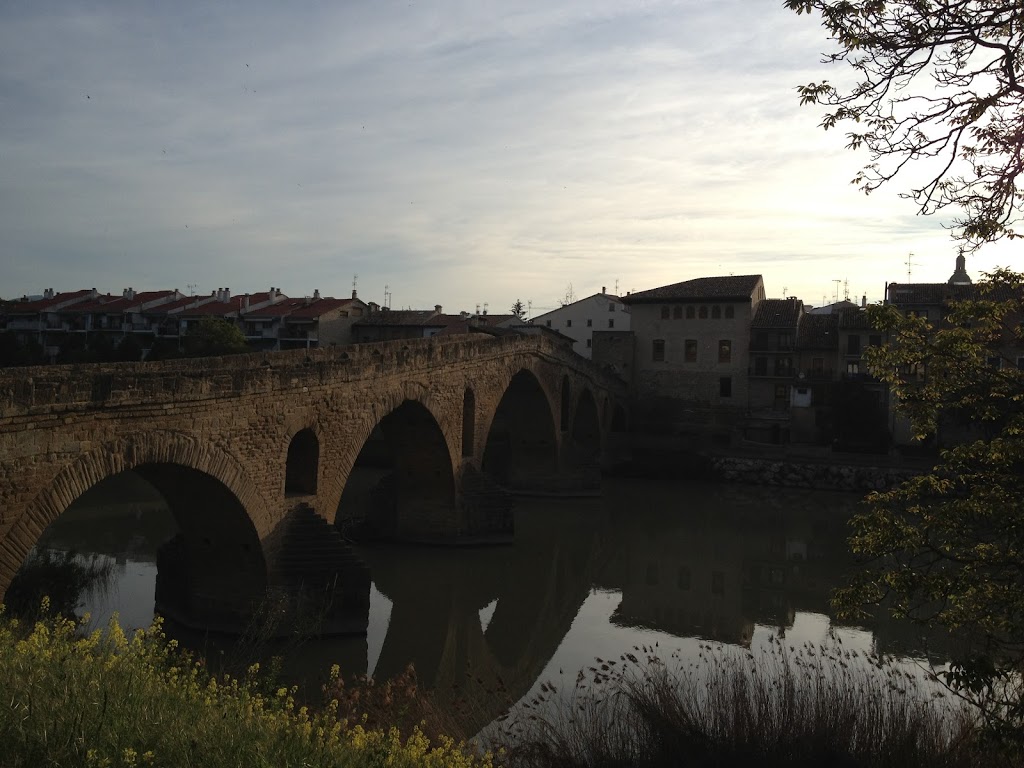
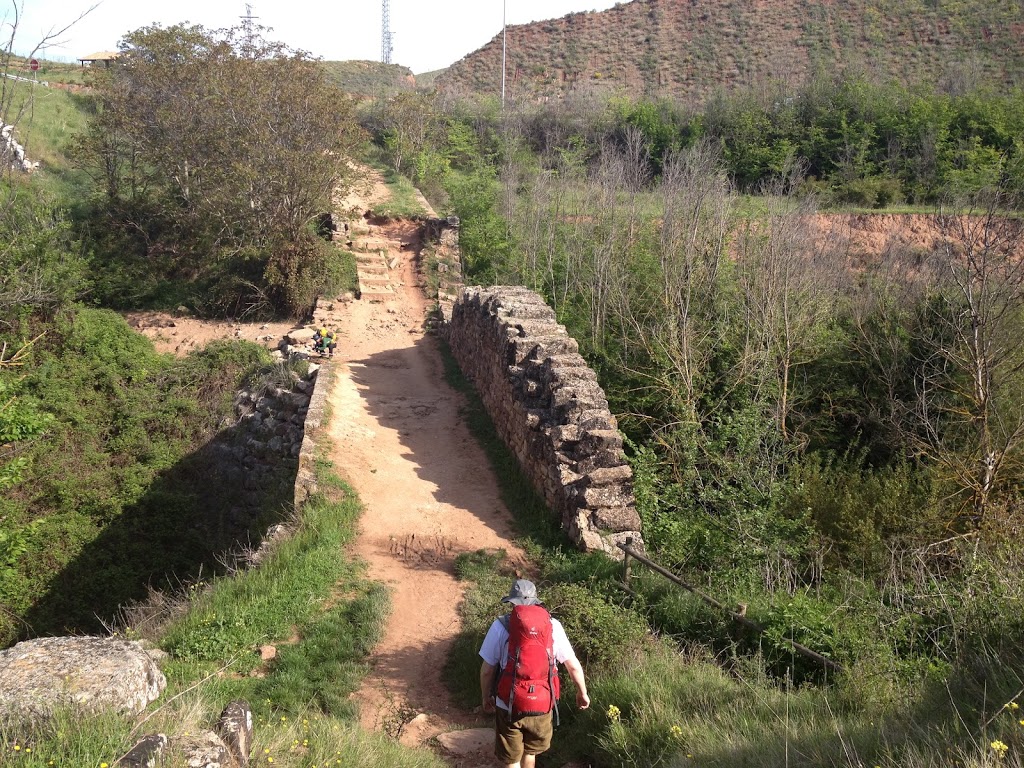
Roman bridge at Cirauqui

crossing the Roman bridge

the hike between Puente la Reina and Estella was challenging — the temperature reached 26 degrees Celsius by the time we reached our destination and we had trouble finding lunch and a place to refill water during the day. we also learned what the sun can do to the back of a pair of legs if given motive and opportunity.

the name of this town — Cirauqui — means “nest of vipers” in the Basque language, alluding either to the snakes found among the rocks on this steep hill or bandits that roamed the hills nearby. the town grew in three stages beginning in the 9th century, and some of the nicer manor houses remain with familial crests above central doorways throughout town. one of the more interesting monuments in the town is the Civil War monument, which only lists victims on the Nationalist side (fighting for Francisco Franco). while many towns removed the ubiquitous monuments after Franco’s death, loyalty to the Falange movement that brought him to power remained strong in Navarra and in some places these memorials remain.

as the title of this post also alludes to, we climbed over a Roman bridge just outside of Cirauqui. while much of the Camino follows old an old Roman road, the path down the hill leaving Cirauqui and over this bridge are the best-preserved of the entire route, by far. granted, some of the paving stones were repaired or replaced during the Middle Ages, but the essence remains — and besides, a bridge from the Middle Ages is still a sight more impressive than anything I walk over on a daily basis. as our cultural guide explains, the method for constructing our modern roadbeds doesn’t differ much from those used by the Romans. a shallow trench is dug and filled with a layer of gravel, tamped down, bordered by large, vertically-set blocks, and filled in with closely-fit paving stones. it’s interesting to think that the workers digging out, marking off, filling in and paving over Trumpy Road near our house are following in the footsteps of the people (probably local slaves) that built this road and bridge thousands of miles and years away.

an “early Gothic” bridge that dates from “only” the medieval era

Alto de Perdon

we had lots of firsts on our hike from Pamplona to Puente la Reina, foremost being our first really sunny day. a good night’s sleep and wonderful breakfast at the Palacio Guendulain had us leaving a bit later than the previous two days, which made the day even more challenging.

leaving Pamplona we walked through the campus of the University of Navarra (you know, the one run by Opus Dei) into a valley where, apparently, the city used to hang felons convicted of theft. beyond the village of Cizur Menor are the ruins of the original Guendulain manor house dating from the 16th century. from here we started an increasingly steep climb up the mountainside, stopping briefly in Zariquiegui to catch our breaths and refill water sacks from the tap next to the church. it was on the ascent into Zariquiegui we saw our first rescue vehicle — a guarda civil followed shortly by some EMT-looking types — assisting someone who hadn’t prepared for the day’s climb or heat. just above the town there’s a fountain of legend — the story goes that the Devil appeared before an exhausted and thirsty peregrino and offered him water if he would renounce his faith; the peregrino refused and Santiago appeared and led him to the fountain that remains today where the Saint offered him a drink from a scallop shell.

a hermitage and basilica once stood at on the Puente de Perdón which ran a hospital for peregrinos that is documented to have functioned until at least 1816. the buildings no longer remain, replaced by a line of wind turbines along the ridge — a parque eólico — built in the region around Pamplona. in 1996, the association of friends of the Camino constructed an impressive and evocative monument to peregrinos in the gap of wind turbines along the ridge. both our guidebook and the cultural “handbook” I’m browsing now bemoan the change wrought by the turbines — adding their “pfoomp pfoomp” to “ruin” the peace of the Camino. I cannot agree on this count — the turbines are incredible feats of engineering to behold and this is by far the closest I’ve ever been to one. you see them frequently along the Camino and I found it a great reminder of how the Camino and peregrinos have changed over the centuries.

the puente of Puente la Reina

Puente la Reina lies at the meeting of two paths of the Camino – that from France and that from Aragon. not surprisingly, the king established the town in the early 12th century to serve and assist the flow of peregrinos.

in the early 11th century, peregrinos had to rely on ferry operators up and down the banks of the Arga to get them across to continue their Camino. not surprisingly, there were some unscrupulous characters operating these ferries doing their best to hoodwink, misdirect, or just plain rob unsuspecting peregrinos. (obviously an age-old problem: who’s going to complain about terrible service when they’re never going to be in that position ever again? and how would you communicate that information anyway? fortunately, we didn’t have much of that on our Camino.) to eliminate this problem, a Queen of Navarra (usually thought to be Doña Mayor, wife of Sancho III of Pamplona, or Doña Estefanía, wife of García III of Nájera) ordered the construction of a bridge over the Agra.

the bridge has six arches, the most easterly of which is now underground. When it was built it also had three defensive towers, one of which featured carvings of the Virgin of Puy (which means bird) and which, according to legend, a bird came to wipe away cobwebs and wash the statue’s face with water from the river.

the town flourished for several centuries; the Templars were present for a period; several churches were constructed; citizens participated to varying degrees in wars, rebellions and the Carlist wars. besides the bridge, there’s a Templar-built church with a unique Y-shaped crucifix said to have been carried by German peregrinos from their homeland.

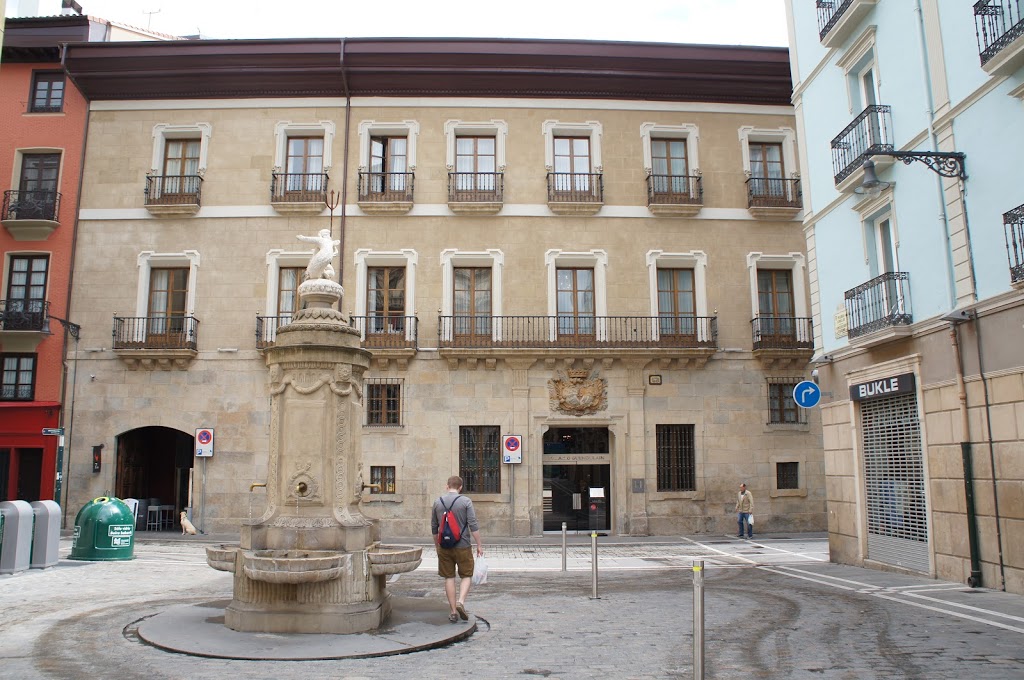
Palacio Guendulain

I hadn’t intended to mention our accommodations in Pamplona, but looking back through our photos I am reminded of how spectacular it was — character, comfort, and spectacular location. it was built in the 18th century by the Viceroy of Nueva Grenada and served as a family residence in the heart of old town for over two centuries. in 1845, Queen Isabella II took over the mansion for several days, converting it into a royal residence. more recently, the current Count of Guendulain had the mansion converted into a luxury hotel, as he resides in Madrid and presumably doesn’t need the whole place to himself (especially when it makes for a handy business proposition). there’s an 18th century carriage housed in the lobby on the first floor, as well as a collection of classic cars in the interior courtyard. while not the most comfortable beds we slept in or the most modern bathroom we got to enjoy, the bed and tub were quite comfy and the view into the interior courtyard was quite remarkable.

laundry time!

if you want to see more pictures, check out the Hotel Palacio Guendulain website. pretty remarkable.

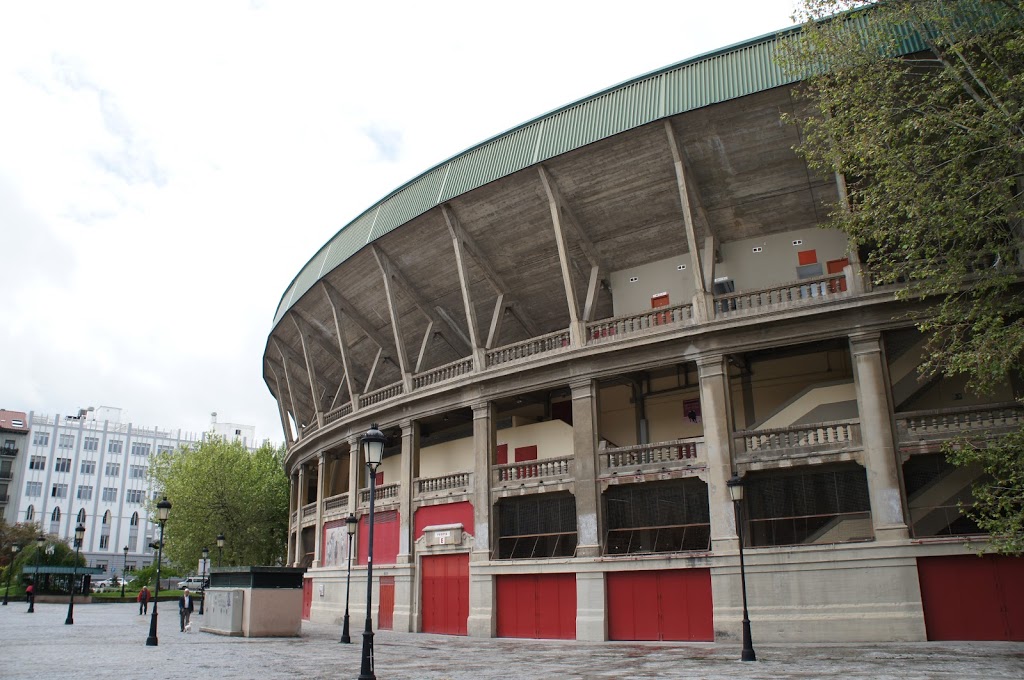
Bulls in Pamplona

as probably everyone knows, bulls play a big part in popular perception of Pamplona — and Spain, really. despite the lunacy of the activity, the running of the bulls every July 6-14 draws massive crowds every year and is broadcast live by two national television stations. to participate in the encierro, participants dress in the traditional garb of the San Fermin festival: white shirt and pants with red waistband and neckerchief. they hold the day’s paper to distract the bull’s attention if necessary. the bulls are released from their corral at 8:00 a.m. every morning of the San Fermin festival, beginning on the 7th. the course is 908 yards long from corral to bullring, lined with wooden barricades where the width of the street allows for it, while elsewhere the buildings serve that purpose. bulls and humans run the course in about 4 minutes.

I couldn’t find information about number of participants per year, but between 200 and 300 people are injured each year, mostly with minor contusions. since 1910 (when records began), 15 people have died — most recently in 2009. most fatalities occurred in the bullring, which is only used during the 9 days of the San Fermin festival. contrary to what I recalled, bullfighting is still common throughout most of Spain, including in Pamplona during the San Fermin festival. the original structure dates from 1923 with an addition from the 1960s. if you don’t care about seeing the first one or two bulls, apparently you can get a good price from scalpers outside the bullring once fights have begun; otherwise tickets are very expensive.

while the encierro in Pamplona is by far the most famous, they occur throughout Spain and Portugal during the year, and even took place for 700 years in Stamford, England, before ending in 1837. the origins of the tradition are hazy, though likely arise from young hotshots deciding to show off their prowess by joining bulls as they ran from corral to bullring for bullfights, or from corral to some other location. the San Fermin festival itself evolved from several festivals including that of San Fermin, who is the patron saint of Pamplona and Navarra, the bullfighting festival, and other commercial festivals.

the walled city of Pamplona

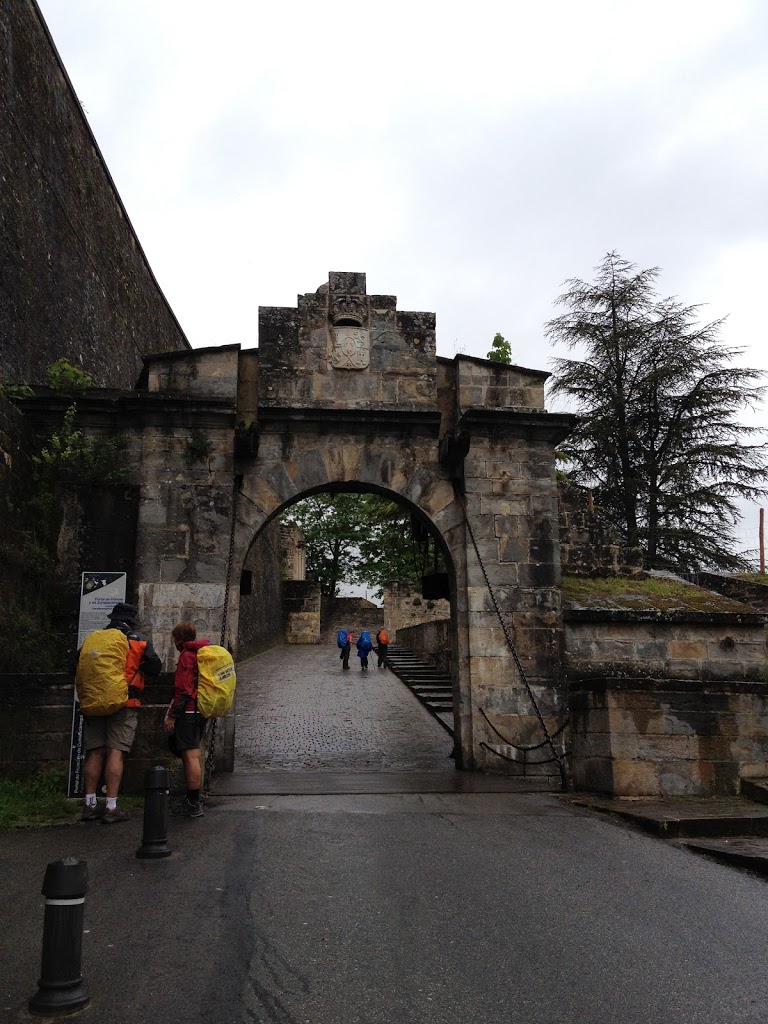
of all the medium-to-large sized cities we walked through, nothing compared with the approach to Pamplona. it was damp during the last several kilometers, but not enough to properly be called “rain.” unlike later cities (looking at you, Burgos) the suburban sprawl to the east of Pamplona is limited and relatively picturesque. after crossing over the river, the walls of the city loom up suddenly behind the trees and demand a moment to take them in.

in 75-74 BCE, Pompey set up camp on the site of what is now Pamplona, establishing the village that over centuries grew into the city we see today. it later became the primary city of the Vascones (Basques), called Iruña. the intervening centuries saw the city controlled by all manner of rulers — Visigoths, Basques, Muslims. for a period after the Muslim conquest of Pamplona in 715, things remained stable as the Basques near the Pyrenees seemed disinterested in repulsing or ousting the Moorish troops and the city may have even flourished. as the 8th century progressed, however, control over Pamplona vacillated between Moorish and Frankish control with neither side able to gain satisfactory control. in 778 as he fled back towards the Pyrenees, Charlemagne is said to have destroyed the walls of the city (if not the entire city) in a bid, as mentioned, to prevent his enemies from using it in the future. this went counter to agreements he’d made not to attack the city walls and may have spurred Basque rebels into the ambush and battle that destroyed his rearguard in Roncevaux Pass.

city prospects revived again in the 11th century, helped by the flow of peregrinos along the Camino. the city enlarged with two additional boroughs in the 12th century — meaning three distinct (and often conflicting) towns existed within the city’s fortress walls. the king unified the boroughs into one city in 1423, which remained the capital of the autonomous kingdom of Navarra after its annexation to Spain in 1512. Castilian conquest a year later and advancements in military technology prompted enhancements to the city defenses, including the construction of a massive star for on the city’s south and fortification of the city walls. the walls we passed through date from the late 16th to 18th centuries. 


because of the city’s military importance, the walls restricted growth — expansion had to go up rather than out, resulting in tall buildings, warren-like streets, and a dearth of open spaces and courtyards. by the end of the 19th century, housing density reached a critical limit and modifications to the star fort allowed an expansion by six city blocks. woo! three decades later, however, the advent of the First World War and its attendant military advancements rendered Pamplona’s existing defenses useless and in short order the southern wall was demolished to allow for rapid urbanization and expansion from the 1920s to the 1950s and into the present day.


Pamplona is the home to the University of Navarra (ranked as the best private university in Spain and the campus of which we walked through on our way out of the city) as well as the infamous Opus Dei, which operates the University. city industry is diversified with the automotive industry making up the largest part. renewable energies are also increasing their presence in the economic sector — which is evinced by the line of wind turbines dotting the ridge to the west of the city (about which more in my next post). nearby Sarriguren is home to the National Centre for Renewable Energies.


and of course there’s the (in)famous running of the bulls every year in July during the Festival of San Fermín. can’t say I’m sad we missed it — there’s no way we would have gotten a room at our awesome hotel and would have had to contend with thousands of people while we made our way wearily out of town just as they’re releasing the bulls.

Zubiri

the journey from Roncesvalles to Zubiri was our first lesson in the short-comings of our guide book. while it recommends continuing on to Larrasoaña — a further 5 or so km — with the afterthought addendum “if you’re feeling muy fuerte” we were more than ready to stop in Zubiri for the night. it was the first of many experiences in one of the numerous small villages that make up the majority of the stops along the Camino, as well as another albergue experience that quickly amounted to a strong preference for private rooms with fewer snorers and private showers wherever they might be found.


Zubiri is named for the bridge that connects the Camino to the town, crossing over the rio Arga. the name comes from Basque and roughly translates to “town of the bridge.” originally constructed in 1097, the current bridge dates from the 14th century. it’s known as the Puente de la Rabia because of a tradition (or legend) that held that walking around the central pillar three times would cure a domesticated animal (e.g. sheep, horses, cows) of rabies. until the 20th century farmers would bring their animals to receive help from the 5th century virgin-martyr Saint Quiteria, whose remains might have been found or ended up here.


the second day was challenging in a whole new set of ways. it still hadn’t really set in that we were in this for the long haul, though I worked assiduously on not thinking about how many days of walking we had left. even though on some level I knew we couldn’t possibly be facing 33 more days as arduous as the ascent over the mountains into Roncesvalles, I didn’t have any evidence yet to prove otherwise. swollen feet were my worst enemy the duration of the Camino and they showed up with a vengeance on this day; my body wasn’t prepared for the reality of walking for hours every day, for days on end.


physical pain aside, the countryside had a lot to offer, all of which differed from what we saw the on the preceding day. apart from a few days in the middle as we crossed the plains of Castilla y Leon, the terrain differed every day — offered new and incredible vistas and presented unique challenges. on this day, for example, we saw our first group of domesticated animals moving as a herd. after a brief rest and not-yet-underwhelming bocadillo in Espinal, the main road through town was briefly swarmed by sheep moving out to pasture. the shepherd and his dogs kept everyone in line, plodding along determinedly, the old sheep straggling along at the rear with periodic canine astonishment to stay with the group.


in all honesty, I am surprised we didn’t see more herds of farm animals moving through towns. we saw plenty of animals out in fields, sure, but only two or three in being shepherded to a new destination. suppose the farmers were up before even the peregrinos seeing to their animals and getting them out for a nice long, sunny meal in the pasture.

menu del peregrino

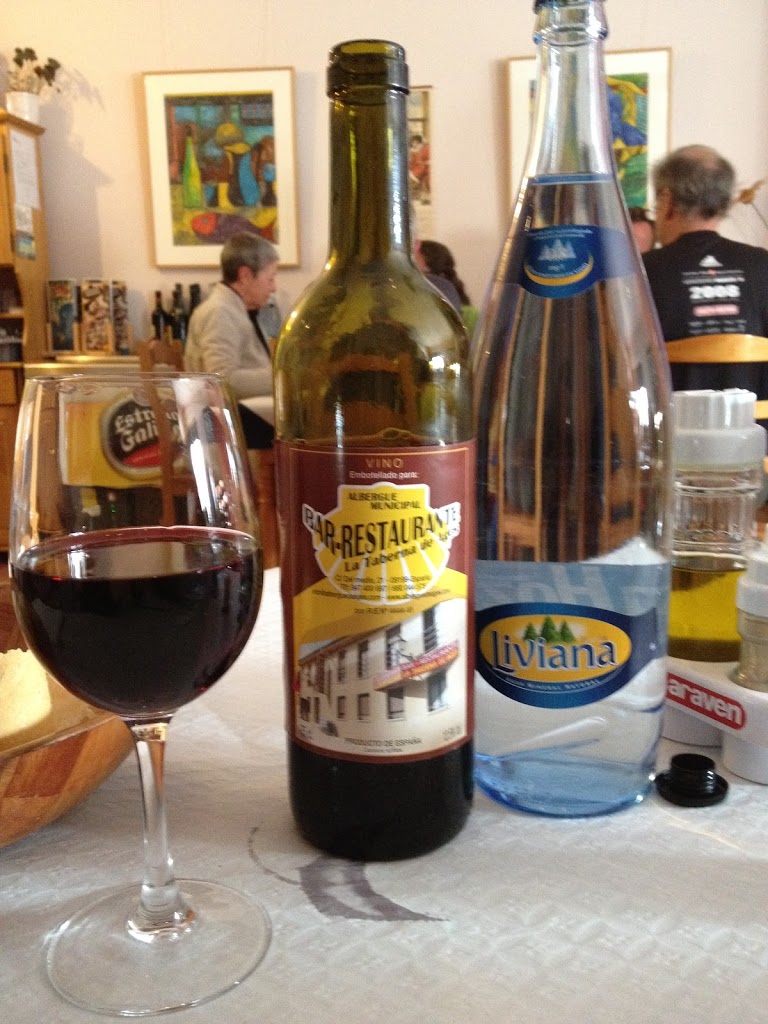
house wine in at the municipal albergue in Ages

as I wager many of you know, Spain is known for their late dining habits. restaurants routinely do not open for dinner until 9:00 p.m. or later, which proves monumentally inconvenient for peregrinos who start hiking by 7:00 a.m. each day and hope to be asleep, or at least in bed, by 9:00 p.m. to adjust for this, along the Camino many, if not all, restaurants offer a fixed menu del peregrino that gets served around 7:00 or 7:30 p.m. for about 10 euro, you get a starter, an entree, dessert, bread, water, and wine.


our first experience with the menu del peregrino was in Roncesvalles; the upscale hotel next to the albergue advertised theirs well and had us walking through the door to reserve seats before we knew how big town might be. the advertised start of the meal was 7:00 p.m. but when we showed up at 7:02, or so, nearly all the  50 or so seats were filled — fellow peregrinos as hungry as we were anxious to get a jump on the meal. this particular meal was served family style on long tables, which fostered a communal feel that resulted in my receiving about six left-over dessert yogurts at the end of the meal. the main course was fish and when word made it down the table that I don’t eat fish, people passed the yogurt served as dessert that they either didn’t care for or didn’t have room to eat. I managed to eat about four before tapping out; it was the best yogurt I ate the entire time we were in Spain.

my favorite meal — at the Hotel Dona Mayor in Fromista

while occasionally we had family-style peregrino meals (usually at private hostels that also had menus or restaurants), usually we had a table to ourselves. the menu options were always fixed to three or four options per course and were never veg-friendly; even the uninspired iceberg lettuce salads came with hard boiled eggs and tuna. even thinking about it now exasperates me (and re-inspires me for the CSA salad I’m eating for tomorrow’s lunch). once I figured out how to manipulate the menu, I managed fine by ordering two veg-friendlier first courses — often soup and pasta with tomato sauce. after a while, the pork or beef stock they used to make the soup got frustrating, but it for a time it served as a welcome alternative to terrible salads. on one memorable occasion, I ordered pasta with tomato sauce without meat and, as often happened, it came out with ham and chicken in the sauce anyway; our server/owner of the establishment was aghast and swept the plate away before I could take another bite to make a plate without meat. I’m never one to make a fuss about meals not coming out as expected and would have eaten around the ham and chicken, but after two weeks it was nice to have someone look after my dietary preferences.

Roncesvalles

the village of Roncesvalles has served pilgrims coming over the pass since the 9th century and in the late 12th century, Sancho VII El Fuerte ordered the construction of a church, done in the Gothic style. his remains and that of his wife now lie in the crypt of the church. in 1400, fire destroyed the original church building, though other structures survived, including the chapel of Sacti Spiritus, which stands over a crypt where Roland is reputed to have stabbed himself after the defeat in the Pass and served as a burial place for peregrinos that perished on the Camino. a bishop from Pamplona bolstered Sancho VII’s decision by creating a co-fraternity to administer to peregrinos at Roncesvalles. in the 13th century, Navarre underwent a period of prosperity which served to enhance the power of this co-fraternity even more; by the end of the 14th century their strength was such that the Navarrese Crown borrowed money from the collegiate at Roncesvalles. reforms over the 16th and 17th centuries enhanced their position, which were threatened by the French Revolution and instability that followed in the late 18th and early 19th centuries.


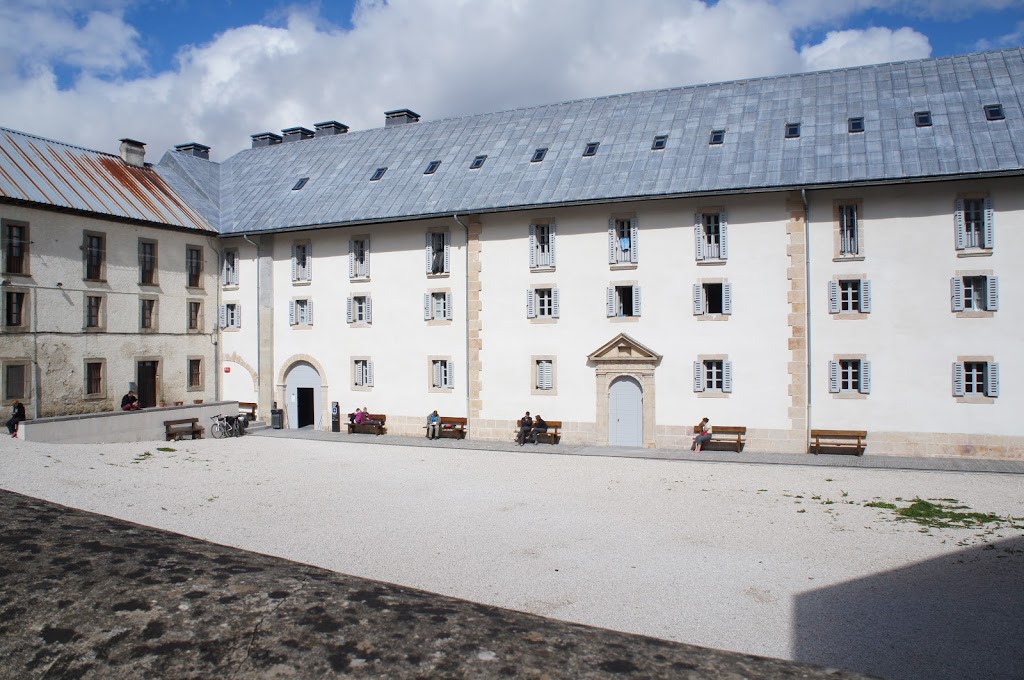
as a first experience with albergues (aulberge in French), the one in Roncesvalles was about what I anticipated from one of the most popular points of origination for the Camino. the space we stayed in was recently renovated and modernized to match the rapidly increasing demand for beds and amenities. previously, up to 120 people bunked in the same large room in the collegiate facility on the main road next to the river. the new building (seen above) was converted from an old youth hostel (I believe) and has something like 300 beds on three floors, which are broken up into little bunk alcoves of four beds with a locker for each bed and had a reasonable three-showers-per-gender-per-floor ratio. the Russian guys sharing our alcove snored like the dickens but weren’t the worst we endured by a long shot (our roommates the next night in Zubiri was muuuuuuuch worse).

Roncesvalles from Col de Lepoeder – today’s peak

Roncevaux Pass — now with animals!

the hike over the Ronceveaux Pass was one of the most challenging of our trip. it’s not uncommon for people to stop the night in Orisson, which is only about 8km from St. Jean-Pied-de-Port. it’s a strenuous climb to reach Orisson, which has the only albergue (and only amenities) before you reach Roncesvalles, and only gets more challenging as your continue on another 20km. (if you’ve ever seen Emilio Estevez’s “The Way”, his character perishes on this segment when he takes a wrong turn and gets lost in the mountain fog.)

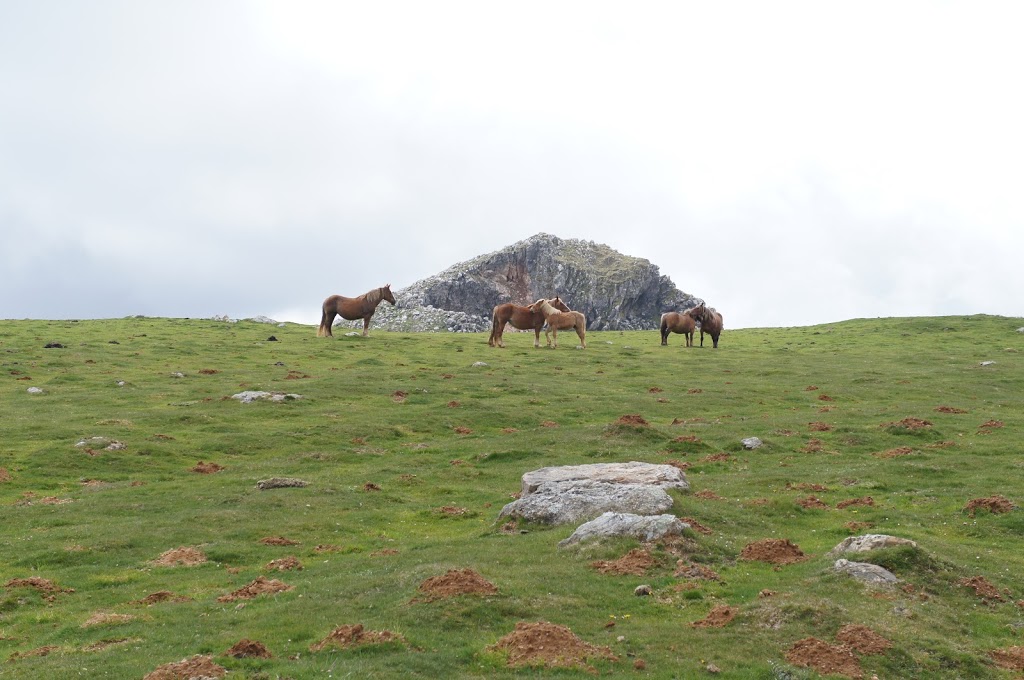
once beyond Orisson, we saw lots of animals grazing in the high mountain fields; probably more herds of animals on this day than an other single day of our trek. some of the horses had bells around their necks, as did the sheep. we didn’t try to approach them, but they seemed wholly unfazed by our presence — suppose you’d have to grow accustomed to so many random humans wheezing their way through your breakfast chomp.

in 778, Charlemagne retreated from Spain, and destroyed the city walls of Pamplona as he did so despite assurances that he would not — perhaps to prevent Basque or other fighters from using the city’s considerable defenses in future rebellions. as the army crossed the Pyrenees, a group of Vascones (people native to this region of Spain at the time the Romans arrived) attacked the rear guard, generating mass confusion and leading to disarray and devastation in the French army. Roland was among those killed and, as  anyone who studied French for any length of time might recall, immortalized in the Chanson de Roland, a somewhat romanticized account of the battle. a stone commemorates the location in the pass where most historians believe he fell (which we walked past) and the Chapel of the Holy Spirit in the village of Roncesvalles.

as challenging as this leg proved, the terrain was remarkable: lush green fields grazed by animals; imposing rock faces; dense forest with fallen leaves lying inches deep; stunning panoramas; even snow! though we ultimately found our guidebook more hyperbolic and unreliable than useful, the admonition to stay attentive on the descent that day was helpful. after straining under unaccustomed weight for an unaccustomed distance for hours uphill, it could have been easy to misstep on uneven terrain — and we even took the “easy” route down the mountain into Roncesvalles as the steeper, wooded route was too sloppy from rain in the preceding days. needless to say, we were both very happy to see the welcoming doors of the albergue run by the Real Collegieta de Roncesvalles.